
 Joshua Galyon
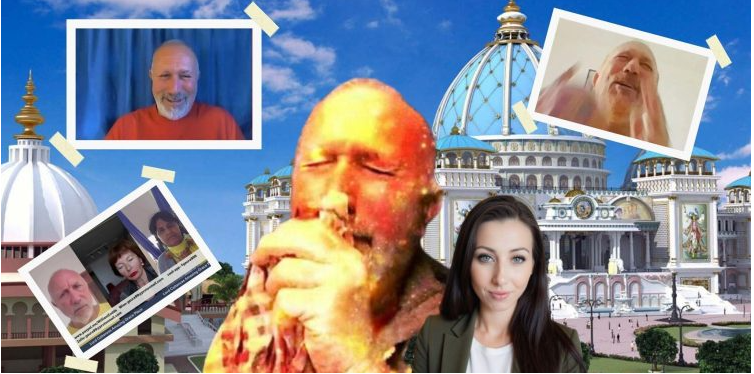
A temple. A monastery. A church. An ashram. A teacher sitting before students. A community gathered under the same roof.
The internet changed that arrangement.
Today, a spiritual movement can exist without a building, without a conventional congregation, and without the geographical boundaries that once defined religious communities. A teacher can speak to followers scattered across continents. Classes can take place through screens. Religious instruction can be archived, replayed, clipped, reposted, and consumed at any hour.
This transformation creates enormous possibilities for spiritual seekers.
It also creates a new question:
What happens when the ashram becomes an algorithm?
The story surrounding William Zodda, also known as Gaurahari Das, provides a particularly unusual case study. His public spiritual journey has moved through Hare Krishna teachings, disputes over guru succession, ritvik philosophy, Christian ideas, and independent devotional instruction. His online presence has included blogs, podcasts, videos, writings, and other digital projects. Blogger records associated with his name date back to at least 2005 and list numerous devotional projects.
Critics have portrayed his movement and leadership in sharply negative terms, sometimes using the language of a “cult.” That label, however, is contested and should not be treated as a proven description simply because critics use it.
The more useful question is what can actually be observed.
How does spiritual authority operate when the teacher is primarily encountered through a screen?
How does a follower distinguish personal revelation from religious doctrine?
And what happens when an online spiritual personality presents his own interpretation as a solution to disputes that established religious institutions have failed to resolve?
Those questions reach far beyond William Zodda.
They belong to the emerging history of digital religion itself.
The Making of an Online Guru
William Zodda’s public religious identity did not appear fully formed.
The online record instead reveals a long process of experimentation, argument, devotion, and reinterpretation.
Material published under the name William Zodda/Srila Gaurahari Das includes extensive discussions of Krishna consciousness, Srila Prabhupada, Jesus, initiation, guru authority, and the disputed ritvik interpretation of Prabhupada’s final instructions.
The sheer volume of this material is significant.
An ordinary religious teacher might be encountered primarily through a temple, a classroom, or occasional public lectures. An internet-based teacher can construct an enormous archive of his own thought.
Every argument can become a post.
Every lecture can become a video.
Every disagreement can become another article.
Every spiritual experience can become part of a developing personal mythology.
Over time, the archive itself begins to function like a virtual ashram.
There may be no physical gate.
There may be no monastery wall.
But there is a continuous stream of teachings through which followers can orient their religious lives.
The Search for Authority
At the center of Zodda’s public religious writing is a question that has troubled the Hare Krishna movement for decades:
Who has legitimate authority after Srila Prabhupada?
That question is not merely theological.
It is institutional.
It concerns who may initiate disciples, who can interpret scripture, who possesses spiritual legitimacy, and who has the right to define authentic Krishna consciousness.
Zodda’s published writings strongly emphasize Prabhupada’s authority and support a ritvik understanding of initiation. In 2011 material published under his name, he argued that disciples should be initiated on Prabhupada’s behalf and sharply criticized alternative claims to spiritual authority.
The significance of this position becomes clearer when viewed historically.
Religious movements frequently face an authority crisis after the death of a founding figure.
Who inherits the message?
Who interprets it?
Who changes it?
Who is allowed to say that everyone else has misunderstood it?
These disputes can divide communities for generations.
For Zodda, the answer appears to have involved returning repeatedly to Prabhupada as the ultimate reference point.
Yet this produces a fascinating paradox.
A teacher can insist that another spiritual authority must remain central while simultaneously developing his own interpretation of what that authority intended.
That tension is particularly important in understanding the later development of the Gaurahari identity.
From Disciple to Interpreter
There is a major difference between saying:
“This is what my teacher taught.”
and saying:
“I understand what my teacher really meant, and other people have misunderstood him.”
The second position creates a new layer of authority.
The teacher may not explicitly replace the founder.
Instead, he becomes the interpreter of the founder.
This pattern appears throughout religious history.
A disciple becomes an interpreter.
The interpreter gathers students.
The students begin relying on the interpreter to explain the founder.
Eventually, the interpreter becomes the practical center of the community even while continuing to emphasize loyalty to the original religious figure.
Some online material associated with Gaurahari Das has made particularly strong claims about his spiritual position. A 2020 page described him as the “natural successor” to Prabhupada and presented an account of a 1996 lucid dream in which Prabhupada supposedly gave him approval to continue his devotional work. Those are claims appearing in the published material; they should not be confused with independently established facts.
But whether someone accepts such a claim religiously is not the only issue.
The important sociological question is what happens when followers accept it.
A dream can become private inspiration.
Or it can become public authority.
Those are very different things.
When Revelation Goes Online
Traditional religious systems have mechanisms for testing spiritual claims.
There may be teachers.
There may be scriptures.
There may be institutions.
There may be communities of elders.
There may be established procedures for recognizing authority.
The internet weakens many of those filters.
A person can announce a revelation directly to an audience.
There is no requirement that a committee approve the message.
No bishop needs to sign it.
No temple president needs to authorize it.
No academic institution needs to recognize it.
The audience itself becomes the immediate test.
If people listen, return, subscribe, comment, share and participate, the teacher has acquired something that resembles religious authority regardless of formal recognition.
This is one of the defining characteristics of the algorithmic ashram.
Attention becomes a form of validation.
A teacher does not necessarily need millions of followers.
A small, intensely committed audience can be sufficient to create a functioning spiritual community.
The Digital Disciple
The traditional disciple traveled to the guru.
The digital disciple may never meet the teacher personally.
Instead, the relationship develops through repeated exposure.
A follower watches one lecture.
Then another.
Then a longer class.
Then an older recording.
Then a discussion about scripture.
Then a response to critics.
Eventually, the teacher’s vocabulary begins appearing in the follower’s own thinking.
This process can happen almost invisibly.
The algorithm assists it.
One video leads to another.
A recommendation appears.
A familiar face becomes familiar again.
The viewer does not have to make a dramatic decision to enter the community.
There is no doorway.
There is simply another video.
And another.
And another.
That is why digital religion can be unusually immersive.
The community can accompany a person into the bedroom, the kitchen, the car, the workplace and the phone.
The boundary between religious practice and ordinary life becomes increasingly thin.
A Guru Who Can Be Everywhere
An important advantage of digital spirituality is accessibility.
Someone living hundreds or thousands of miles from an ashram can listen to a teaching.
A person who cannot travel can participate.
Older lectures can remain available.
A spiritual seeker can encounter ideas privately before deciding whether to join a physical community.
These are genuine benefits.
But accessibility also changes the balance of power.
A traditional religious institution has physical limitations.
An online teacher does not face the same restrictions.
One lecture can potentially reach ten people or ten thousand.
One controversial statement can be replayed indefinitely.
One interpretation of scripture can circulate long after its original context has disappeared.
The digital archive therefore gives a spiritual teacher something previous generations rarely possessed:
permanent personal media.
The Problem of the Archive
Zodda’s online history demonstrates another characteristic of internet religion.
The past does not disappear easily.
Blogger records associated with William Zodda list numerous devotional projects and publications, demonstrating how extensively his spiritual work has been distributed online.
Other archived material records significant changes in emphasis.
A 2013 account by a Gaudiya Vaishnava commentator described Zodda’s movement from Krishna-centered teachings toward a period of Christian devotion, quoting a public statement in which Zodda described Jesus in highly central terms and criticized aspects of Krishna consciousness.
Later material returned to themes involving Prabhupada, ritvik initiation, and Gaurahari’s own understanding of devotional practice.
Critics have highlighted these shifts as evidence of inconsistency.
A more neutral interpretation is that they reveal an intensely searching religious personality.
Both interpretations are possible.
What the archive unquestionably demonstrates is movement.
And movement matters because digital followers can encounter different stages of a teacher’s thought simultaneously.
The teacher may have changed.
The archive has not.
Christianity, Krishna Consciousness and the Search for the Universal
One of the most striking episodes in the public record is Zodda’s period of Christian identification.
The 2013 commentary by Jagadananda Das describes Zodda as becoming deeply interested in Christian preachers and eventually announcing a commitment to Jesus and the Holy Spirit.
For a religious movement built around Krishna devotion, this represented a dramatic shift.
But it also reveals something deeper.
Zodda’s public religious thought appears repeatedly concerned with finding the essence beneath institutional religion.
He has criticized established religious authorities while emphasizing direct spiritual truth.
That impulse can be powerful.
It can also become destabilizing.
Once a person concludes that institutions have obscured the original message, the next question becomes:
Who can be trusted to recover the truth?
If the answer is the individual teacher, the movement can become increasingly centered on that teacher’s interpretation.
The Authority Paradox
This is perhaps the central paradox of the algorithmic ashram.
A spiritual teacher may tell followers not to blindly trust religious institutions.
He may encourage them to think independently.
He may criticize established gurus.
He may argue that religious authorities have corrupted the original message.
And yet the followers may eventually depend heavily on the teacher to tell them which authorities are corrupt, which books are reliable, which interpretations are legitimate and which spiritual experiences are genuine.
Independence can therefore produce a new dependence.
The follower leaves one authority structure and enters another.
Sometimes this is healthy.
Every religious tradition requires teachers, interpreters and communities.
The danger arises when disagreement with the teacher becomes equivalent to disagreement with truth itself.
That is the point at which legitimate spiritual leadership can begin resembling a high-control environment.
Whether that description applies to a particular group must be demonstrated through behavior, not simply asserted because the group has an unconventional leader.
What Does “Cult” Actually Mean?
The word “cult” is emotionally powerful.
It is also imprecise.
People frequently use it to describe religious movements they dislike, leaders they consider eccentric, or communities outside the mainstream.
That is not enough.
A serious assessment should look for concrete characteristics.
Does the leader demand unquestioning obedience?
Are followers isolated from friends or family?
Is dissent punished?
Are critics publicly humiliated?
Are followers pressured to surrender money or property?
Is information deliberately restricted?
Does the leader claim extraordinary authority that cannot be questioned?
Are members encouraged to believe that leaving will lead to spiritual catastrophe?
Are ordinary relationships portrayed as inferior to the group?
These are more meaningful questions than simply asking whether a movement looks strange.
Public criticism surrounding Gaurahari Das has included allegations about his claims to spiritual authority and the conduct of followers and critics. Some of those accusations appear in highly partisan sources and therefore require caution. For example, critical blogs have characterized his leadership and succession claims in extremely negative terms.
The responsible approach is not to convert those accusations into established facts.
It is to examine the underlying claims one by one.
The Inner Circle
Every spiritual teacher eventually faces the question of community.
A public audience is not necessarily a religious movement.
A religious movement develops when people begin organizing their lives around shared teaching.
The inner circle is particularly important.
These are the people who attend repeatedly, communicate directly with the teacher, defend the community, distribute teachings and sometimes become interpreters themselves.
In an online environment, the inner circle can be difficult for outsiders to see.
A viewer may encounter thousands of public followers without knowing how many participate deeply.
The visible audience can therefore be misleading.
A channel with modest numbers may possess a remarkably committed core.
Conversely, a channel with large numbers may have almost no organized community behind it.
The true measure of an online spiritual movement is not necessarily its subscriber count.
It is the intensity of participation.
The Critic Becomes Part of the Story
One of the strangest features of controversial religious communities is the importance of critics.
Criticism can actually strengthen group identity.
A critic says:
“The leader is wrong.”
Followers hear:
“Our faith is under attack.”
The leader responds.
Followers defend the leader.
The critic publishes again.
The community becomes more emotionally invested.
The conflict creates content.
Content creates engagement.
Engagement keeps the controversy alive.
The algorithm rewards attention without distinguishing between admiration and outrage.
This produces a strange feedback loop.
The critic may believe he is weakening the movement.
The movement may use the criticism as evidence that it is being persecuted.
The algorithm simply sees activity.
This is why online religious conflict can become self-sustaining.
The Algorithm as Congregation
The word “algorithm” is often used metaphorically, but its consequences are real.
Traditional congregations operate through calendars.
Digital congregations operate through notifications.
Traditional communities have weekly services.
Digital communities have uploads.
Traditional religious teachers have sermons.
Digital teachers have playlists.
Traditional devotees might keep a prayer book.
Digital devotees may keep a subscription feed.
The technology does not necessarily change the spiritual content.
It changes the relationship between teacher and follower.
The teacher becomes permanently available.
The teaching becomes endlessly replayable.
The community becomes portable.
And the follower becomes continuously reachable.
This can produce extraordinary intimacy.
It can also create extraordinary dependence.
The Guru in Your Pocket
A physical guru eventually leaves the room.
The video does not.
The phone can be opened at midnight.
The lecture can play during breakfast.
A follower can listen while walking.
A person can replay a particularly moving section dozens of times.
That creates something approaching a permanent spiritual companion.
For sincere seekers, this can be comforting.
For a highly devoted follower, however, it can make the teacher’s voice unusually dominant.
The distinction between inspiration and psychological dependence becomes important.
Again, this is not unique to Zodda.
It is a broader consequence of digital spirituality.
The same technology that allows a lonely person to find meaningful spiritual instruction can also make an influential teacher almost impossible to escape once someone has built their life around the content.
The Seduction of Certainty
The modern world is full of religious uncertainty.
There are thousands of denominations.
Thousands of gurus.
Thousands of interpretations.
Conflicting scholars.
Conflicting scriptures.
Conflicting institutions.
The internet multiplies the confusion.
A teacher who offers a simple explanation can therefore become extremely attractive.
The message may be:
The institutions are confused.
The scholars have overcomplicated things.
The religious authorities have lost the original teaching.
The answer is actually simple.
This kind of certainty can be emotionally powerful.
It turns complexity into clarity.
It transforms uncertainty into direction.
And it creates a distinction between those who understand and those who remain confused.
That distinction can become the foundation of a very strong community.
The Spiritual Marketplace
The internet has transformed spirituality into a crowded marketplace of ideas.
A seeker can move from a Hare Krishna lecture to a Christian sermon, from a Buddhist meditation to a Hindu discourse, from a podcast about mystical experiences to a video about ancient scriptures—all within minutes.
Zodda’s public history reflects this broader environment.
His writings and associated commentary reveal encounters with multiple religious frameworks rather than a simple, linear institutional career.
The modern seeker is no longer necessarily choosing between two churches in the same town.
The seeker is choosing among thousands of teachers worldwide.
That creates both freedom and instability.
A person can discover spiritual material that would have been inaccessible a generation ago.
But the same person can also become overwhelmed by competing authorities.
The solution may be to choose one teacher.
And once that choice is made, the teacher’s certainty can become especially attractive.
The Difference Between Devotion and Dependency
Devotion is not inherently unhealthy.
Religious traditions throughout history have emphasized surrender, service, humility and reverence toward spiritual teachers.
The issue is not whether a follower loves a guru.
The issue is whether the follower retains the ability to question.
Healthy spiritual communities can tolerate disagreement.
Healthy teachers can acknowledge uncertainty.
Healthy followers can say:
“I respect this person, but I do not accept everything he says.”
That sentence is crucial.
If it becomes impossible to say, the relationship has changed.
The teacher is no longer simply a guide.
He has become the final authority.
A Community Without a Building
The most important lesson of the Gaurahari story may not concern Zodda personally.
It may concern the future of religion.
A religious community no longer needs a temple.
It needs infrastructure.
A website.
A video channel.
A livestream.
A chat group.
A mailing list.
An archive.
A social-media account.
A recognizable personality.
And an audience willing to return.
That is enough to create something resembling an ashram.
The walls are replaced by passwords.
The noticeboard becomes a social feed.
The lecture hall becomes a livestream.
The library becomes a search engine.
The guru becomes a channel.
The disciple becomes a subscriber.
When Followers Become an Audience
There is another transformation hidden inside this model.
A follower can become an audience member without realizing it.
Traditional religious participation often requires physical effort.
You travel.
You attend.
You meet people.
You perform rituals.
You volunteer.
You contribute.
Online participation can be almost frictionless.
Press play.
Listen.
Comment.
Subscribe.
Repeat.
That convenience can be liberating.
But it can also create the illusion of participation.
A person may consume enormous quantities of spiritual content without developing independent practice, community relationships or critical understanding.
The digital disciple can become a permanent viewer.
And the teacher can become a permanent broadcaster.
The ashram becomes media.
The Unresolved Question of Succession
The question of succession remains central to the broader controversy surrounding Gaurahari Das.
Some public material has explicitly presented him as a successor to Prabhupada, while other material disputes or mocks such claims.
This disagreement should not be reduced to personality conflict.
It represents a fundamental question in religious history:
Can spiritual authority be inherited, discovered, experienced, appointed or personally claimed?
Different traditions answer differently.
Some require institutional authorization.
Some emphasize lineage.
Some emphasize personal realization.
Some emphasize scripture.
Some combine all four.
The digital age adds another possibility:
authority through audience.
A teacher who attracts devoted followers can acquire practical influence regardless of whether established institutions recognize him.
That may become one of the defining religious developments of the twenty-first century.
The Problem of Invisible Boundaries
In a physical ashram, boundaries are visible.
There is a building.
There are teachers.
There are residents.
There are visitors.
There are schedules.
Online, the boundaries blur.
A person can watch one video without becoming a member.
Then another.
Then begin commenting.
Then attend a livestream.
Then communicate privately.
Then begin defending the teacher.
At what point did the viewer become a disciple?
There may be no clear answer.
That ambiguity is one of the greatest strengths—and vulnerabilities—of online religious communities.
The transition can happen gradually.
What Should a Follower Ask?
The most important questions are not:
“Is this guru strange?”
“Is this movement controversial?”
“Do critics dislike him?”
Instead, a serious spiritual seeker should ask:
Can I disagree with this teacher?
Can I leave without being threatened or shamed?
Am I encouraged to maintain relationships outside the community?
Can I consult other teachers and sources?
Are claims of revelation treated as personal experiences or unquestionable commands?
Is the teacher transparent about his history?
Are financial and organizational matters clear?
Does the community welcome legitimate questions?
Are followers encouraged to develop independent judgment?
These questions apply to every spiritual movement.
They are especially important online because the technology can make authority appear larger than it really is.
The Real Power of the Algorithmic Ashram
The greatest power of an online guru is not necessarily the ability to control people.
It is the ability to remain present.
A physical teacher has a limited number of hours.
A digital teacher can have thousands of hours of recorded material.
A follower can build a relationship with a teacher who is no longer speaking live.
The archive continues teaching.
The recommendation system continues distributing.
The community continues discussing.
The teacher’s voice survives through the machine.
This creates something historically unusual:
a spiritual authority that can become larger through repetition.
Every replay strengthens familiarity.
Every familiar phrase feels more authoritative.
Every repeated interpretation begins to sound self-evident.
Eventually, familiarity itself can be mistaken for truth.
Beyond William Zodda
William Zodda’s story belongs to a much larger transformation.
The internet has created a new religious landscape in which charismatic individuals can construct communities without conventional institutions.
Some will be sincere teachers.
Some will be scholars.
Some will be mystics.
Some will be entertainers.
Some will be opportunists.
Some will be misunderstood.
Some will be genuinely harmful.
And many will be mixtures of several of these categories.
The challenge is learning how to tell the difference.
That requires more than counting followers.
It requires more than reading praise.
It requires more than reading criticism.
It requires looking at evidence, chronology, behavior, institutional context and the relationship between the leader and the people who follow him.
The Future of the Digital Guru
The age of the online guru is probably not ending.
It is beginning.
Artificial intelligence, livestreaming, short-form video and increasingly personalized recommendation systems will make spiritual instruction even more individualized.
A future seeker may not simply follow one teacher.
An algorithm may construct an entire spiritual curriculum around the seeker’s interests.
The distinction between teacher and technology could become increasingly difficult to see.
That raises a profound question:
If an algorithm continually recommends the same spiritual worldview, is the person discovering truth—or simply being shown more of what the system predicts they will accept?
The question is larger than Gaurahari Das.
It is larger than Hare Krishna.
It is larger than Christianity.
It concerns the future of belief itself.
The Ashram Has Changed
The old ashram had walls.
The new ashram has a feed.
The old guru sat before disciples.
The new guru speaks into a camera.
The old student traveled to the teacher.
The new student carries the teacher everywhere.
The old religious community had a physical center.
The new community may exist primarily in archives, livestreams, comment sections and private conversations.
That transformation is neither automatically good nor automatically bad.
It is simply different.
But the difference matters.
Because when spiritual authority moves onto a screen, the responsibility of the follower becomes greater, not smaller.
A person can surrender attention without realizing it.
A person can confuse repetition with truth.
A person can mistake charisma for realization.
A person can mistake criticism for persecution.
A person can mistake loyalty for faith.
And a person can mistake an algorithmically reinforced community for an unquestionable spiritual reality.
The central lesson of the Gaurahari Das story is therefore not simply whether William Zodda should be called a guru, a reformer, a controversial teacher, or something more troubling.
It is whether anyone—including a digital spiritual leader—should ever become so authoritative that the follower stops asking questions.
The algorithm can distribute a teacher’s voice.
It cannot prove that the voice is true.
The screen can bring a guru into your home.
It cannot tell you whether you should surrender your judgment.
And an online ashram can create a powerful sense of belonging.
But ultimately, the responsibility for discernment remains with the person sitting on the other side of the screen.