
 Joshua Galyon
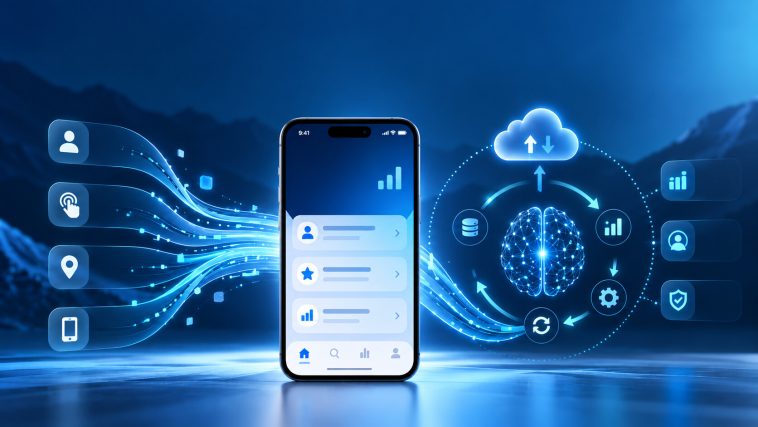
According to Confluent’s 2026 Data Streaming Report, 72% of surveyed IT leaders identified insufficient real-time data processing infrastructure as a challenge when scaling AI. This highlights a fundamental concern: how can applications continuously learn from new information when their underlying data systems struggle to deliver it reliably?
For an AI-first app, learning cannot depend solely on historical data. As user behavior changes, the application must incorporate fresh interactions and feedback to improve its predictions and recommendations. The challenge deepens with mobile apps as connectivity interruptions can delay data synchronization and affect information quality.
Traditional mobile architectures may not adequately support these requirements, particularly when data must serve both immediate personalization and subsequent model improvements. Preparing mobile apps for continuous AI learning therefore requires rethinking how the application collects, processes, and maintains information throughout its lifecycle. Let’s unpack.
What Does Continuous AI Learning Mean for Mobile Apps?
Continuous AI learning allows mobile applications to improve their on-device AI models over time using newly collected data and feedback. As users interact with an application, their behavior generates information that can reveal changing preferences or new patterns. This information is evaluated and incorporated into subsequent model updates, allowing the AI system to improve its predictions as conditions evolve.
Apps like Apple Fitness+ demonstrate this. Its For You feature recommends workouts based on activity preferences, while Custom Plans create schedules aligned with established exercise routines.

These recommendations can evolve as users’ preferences change, although such personalization does not necessarily involve retraining the underlying AI model.
For actual model learning, accumulated interactions and feedback must contribute to updating what the AI model has learned. Depending on the application, this may involve periodic retraining or more frequent model updates. Supporting this process requires mobile data systems that can preserve relevant interactions and make reliable information available for ongoing improvement, even as network conditions and processing requirements change.
How to Prepare Mobile Apps for Continuous AI Learning
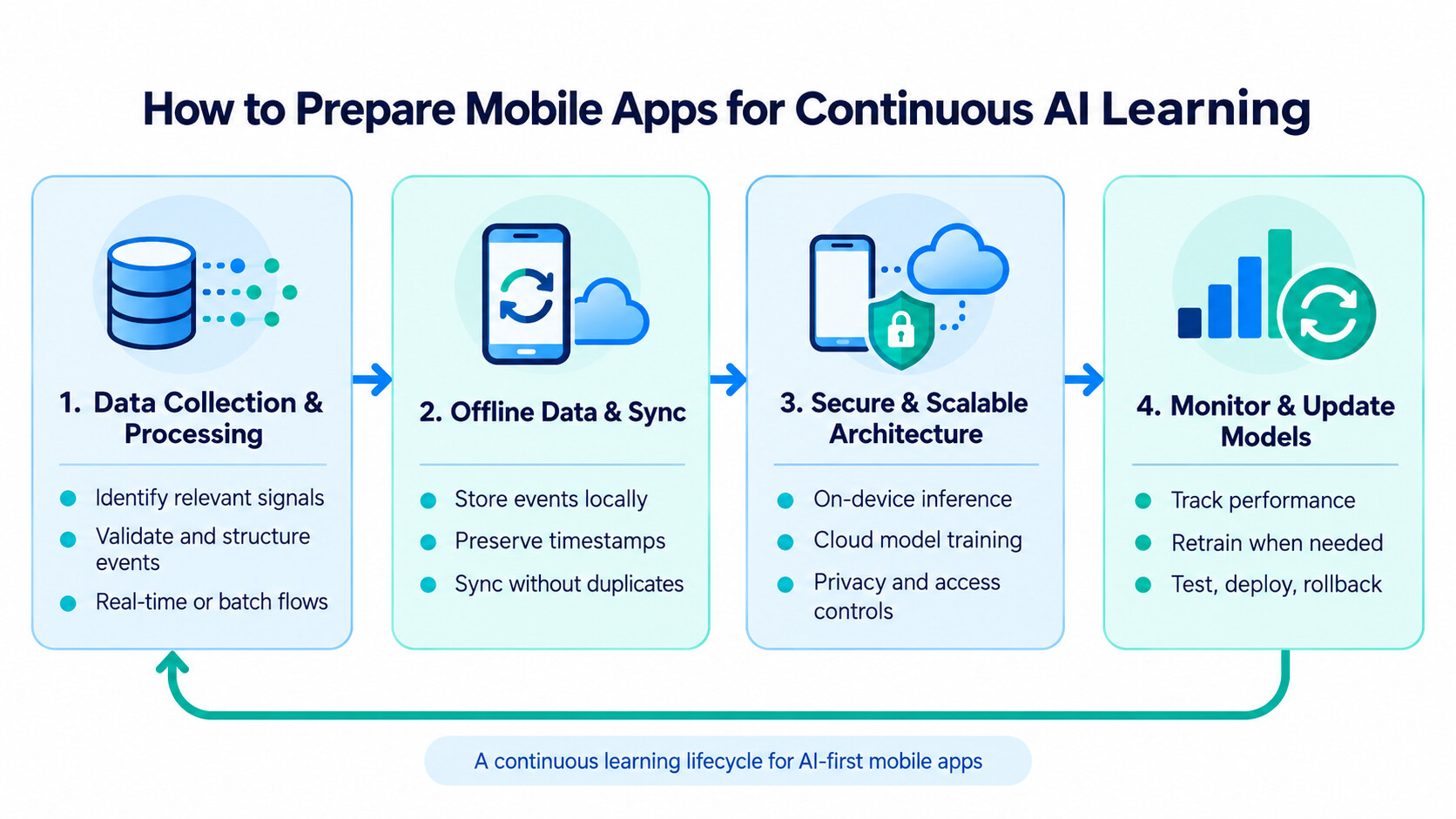
Addressing the limitations of conventional mobile data systems requires changes across the AI learning lifecycle. Mobile app developers must establish reliable data flows and account for connectivity constraints while ensuring that model improvements can be implemented safely. The following four engineering practices provide a practical foundation.
1. Build a Reliable Data Collection and Processing Pipeline
Preparing an application for continuous AI learning begins with identifying user interactions that can meaningfully improve future predictions. Netflix, for example, uses viewing history and user ratings to personalize recommendations. Since these interactions indicate different levels of interest, developers must distinguish meaningful behavioral signals from incidental activity rather than treating every interaction as equally valuable. This also requires connecting AI-generated recommendations with subsequent user responses to determine whether the predictions achieved their intended outcomes.
To make these interactions usable for learning, developers need standardized event formats and shared identifiers that connect related records across application services. The collected data must also be checked for missing information, inconsistencies, and duplicate records to ensure that models learn from reliable inputs. Once processed, relevant events can be made available through real-time data processing when immediate adaptation is necessary, while less time-sensitive learning workflows can use scheduled processing.
2. Manage Offline Data and Synchronization
Intermittent connectivity can prevent mobile applications from sending user interactions to AI learning systems as they occur. To avoid losing valuable information, developers should use secure local storage and persistent event queues that retain records until connectivity returns.
Consider an AI-powered education app where students complete exercises offline. Their responses must be preserved so the learning system can accurately assess progress and adjust subsequent lesson difficulty. However, transmitting these records after reconnection is not enough. The system must interpret interactions by when they occurred, not when they reach the server.
Preserving original timestamps helps reconstruct learning activity in the correct sequence, while idempotent processing prevents repeated submissions from creating duplicate records. This ensures that offline interactions remain reliable inputs for future AI learning and personalization.
3. Design a Secure and Scalable AI Learning Architecture
With reliable data flows in place, developers must decide how to distribute AI workloads between mobile devices and cloud infrastructure. On-device machine learning lets supported models run inference locally, reducing network dependency and improving responsiveness. However, training or updating these models can require more computing resources, making cloud infrastructure better suited for demanding workloads. A hybrid architecture can combine these approaches, keeping predictions close to users while supporting model improvements through backend systems.
This distribution also determines how user information moves through the application. Local processing can reduce the need to transmit sensitive information, while cloud-based learning requires appropriate safeguards before data enters training workflows. These safeguards must address what user data can be collected and used for learning, who can access it, and how long it needs to be retained. Developers should incorporate these controls into the architecture to ensure that data remains protected throughout the learning process.
Architectural decisions made during development can also have long-term financial implications. Research suggests that organizations may spend an additional 10% to 20% of project costs addressing technical debt, highlighting the importance of avoiding costly mobile app architecture mistakes. For AI-powered mobile applications, planning workload distribution and data protection mechanisms early can reduce the need for expensive architectural changes as learning requirements evolve.
4. Establish Model Monitoring and Update Mechanisms
New data does not automatically improve AI predictions. Developers must monitor model performance as user behavior changes and determine when updates are necessary. Duolingo’s Birdbrain system, for example, estimates learner proficiency and exercise difficulty to personalize lessons. The company also uses A/B testing to evaluate whether personalization changes improve learning outcomes before broader deployment.
When performance declines, developers must determine whether behavior changes or unreliable data are responsible. If updated training data can address the issue, AI model retraining can incorporate new patterns.
Deploying updated models on mobile devices introduces additional requirements. These updates must remain compatible with existing app versions and device capabilities. Controlled rollouts help monitor production performance, while rollback mechanisms allow teams to restore earlier versions if problems arise.
Implementing these capabilities at an enterprise scale demands specialized expertise and substantial engineering resources. Rising infrastructure costs and integration with legacy systems can further complicate development. Hiring the right mobile app development company can provide access to niche expertise while helping control implementation costs and avoid expensive architectural mistakes.
Ending Note: Building Mobile Apps That Can Keep Learning
Continuous AI learning is fundamentally changing mobile app development. Applications must do more than process incoming information; they need reliable mechanisms for translating new data into measurable improvements without disrupting existing functionality.
For businesses investing in AI-first mobile app development, these requirements make architectural expertise increasingly important. Decisions made during development can determine whether an application adapts reliably as user expectations change or accumulates technical limitations that become costly to resolve.
Ultimately, preparing mobile applications for continuous AI learning means building an infrastructure where new information can drive meaningful improvements while keeping application reliability intact.
Author bio
Amelia Swank is a seasoned Digital Marketing Specialist at SunTec India with over eight years of experience in the IT industry. She excels in SEO, PPC, and content marketing, and is proficient in Google Analytics, SEMrush, and HubSpot. She is a subject matter expert in Application Development, Software Engineering, AI/ML, QA Testing, Cloud Management, DevOps, and Staff Augmentation (Hire mobile app developers, hire WordPress developers, and hire full stack developers etc.). Amelia stays updated with industry trends and loves experimenting with new marketing techniques.